
By Prema Arasu
Almost half (43%) of senior citizens in Malaysia are physically inactive as stated in a report in Ipoh Echo on August 21st, 2026. The report also noted that Perak is among the states with a high proportion of retirees and elderly residents, many of whom probably do not engage in regular fitness activities.
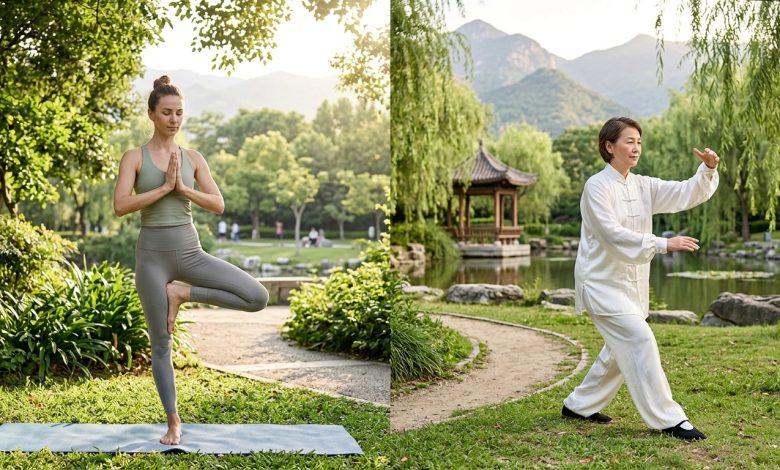
It therefore seemed timely to alert readers about the benefits of Tai Chi and Yoga. To put it simply, especially if you choose not to read this whole article, both forms of exercises can be done in less than 30 minutes and “keep you going and going like Eveready’s Energizer battery.” While it’s never too late to start either practice, a younger body is certainly more able to achieve a higher level of performance and sustain the habit, and benefits, into old age.
A large number of clinical trials, comparative studies and systematic reviews have unequivocally proven that both Yoga and TaiChi positively impact your physical health and sense of wellbeing.
How are they similar and different? Yoga originated in ancient India, Tai Chi in ancient China.
Both exercises –
- involve proper breathing, movement and mindfulness.
- provide a wide range of benefits that help the brain and body, improve balance and prevent falls, reduce tension and enhance your mood. Studies indicate that Taichi reduces falls by 20-45%.
- have styles ranging from gentle to more vigorous routines.
- benefits accrue with regular practice especially under supervised instruction as opposed to self-directed online/video programs. Good instructors always remind students to “listen to your body” by paying attention to and accepting your physical limitations and individual day-to-day variances.
What about differences?
Tai Chi has essentially no floor work or a need to kneel or to place load on the wrists or shoulders; feet can be bare or fitted with flexible, flat-soled shoes with heel and toes at the same height, and sufficient width for the toes to spread. Yoga requires a floor mat or non-slip rug; but there also are different programs such as Chair Yoga that simplify poses and accommodate individual abilities and constraints.
Tai Chi is different in that a particular routine (e.g. Yang 85-step) requires you to continuously shift weight, coordinate movement, maintain an upright posture, and recall the next step in sequence from memory. Yoga emphasizes flexibility, and devotes more time to breathing exercises, poses for spinal mobility, reducing stiffness and back pain, and is especially helpful with relaxation.
Given so much similarity, which should you choose?
Choose Tai Chi if your priorities are: improving balance and preventing falls, walking more stably and confidently, improving sleep quality, being able to remain independent, managing diseases like arthritis and Parkinson’s, and experiencing gentle cardiovascular activity, among other benefits.
Choose yoga if your priorities are: improving flexibility, increasing range of motion, guided relaxation, deep breathing, and reducing muscular tension, among other benefits.
If time, interest and access to classes allow, combining both practices may provide the broadest benefits. Weight lifting for muscle strength and cardiovascular activity should also be considered. As with any exercise, enjoyment and moderation are important while also making sure you include 1-2 days of rest.
About Prema Arasu:
Prema is a retired biomedical researcher and university professor. She enjoys activities such as Yoga and Taichi, being out in nature, and doing short term projects related to science and education. wmnwsdm@gmail.com