
By Prema Arasu
This story, offered to Ipoh Echo’s readership, is aimed at keeping alive the history, hopes and memories of some eminent Perakeans.
(This is the first part of a two-part series)
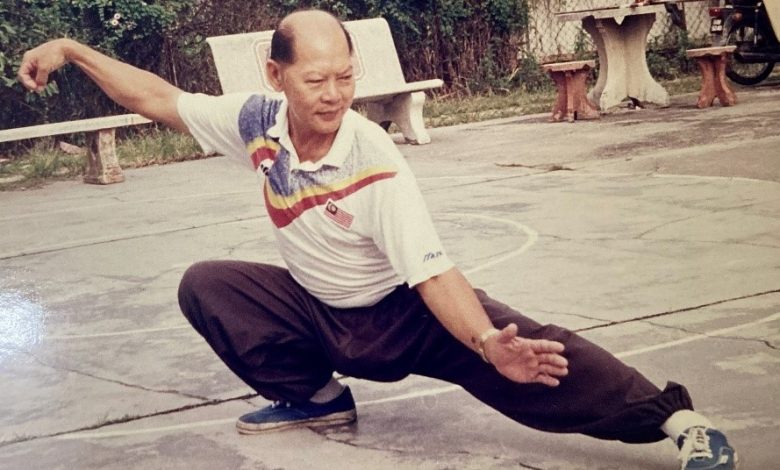
The “Mighty Old One”, as he was named in news stories of the time, Ng Fook Huat was Malaysia’s first TaiChi (Taijiquan) athlete in the Asian Games held in Beijing in 1990. But age is such a relative measure as he was only 49 then. He still continues to practice and teach Wushu at the age of 85. To his many past and present students, he is respectfully addressed as “Sifu.”
Wushu (in Mandarin), sometimes referred to as Kungfu (in Cantonese), includes different forms of Chinese martial arts that have also evolved into exercises for health and wellbeing. Personal testimonies from Sifu’s students, including some with ailments such as arthritis and cancer, felt that regular practice helped them a lot. They experienced significant improvements in their quality of life and reduced dependence on medications. Others noted that group learning enhanced their Taichi practice, social engagement and motivation to attend classes.
Born in Ipoh, and living all his years in beloved Ipoh, Sifu was ninth in a family of 10 brothers and sisters. Somewhat ignored by his older siblings, he remembers keenly watching his next-door neighbor practicing the Praying Mantis style of Wushu.
He shared his life story in a calm and matter of fact way.
I was maybe 10 at the time. My neighbor’s moves were inspiring. Noting my interest, he patiently taught me a few steps. I got hooked.
At 14, my parents didn’t object when I started bicycling over for night classes at the Ipoh Chinese Chin Woo Athletic Association. I studied traditional Wushu under three Masters: Toh Keng Kol; Ho Sau Kol; and, Chan Yew Meng. They were all in their 30s and 40s. Master Chan was the most senior and he taught me a lot, from Hand Wushu to manipulating weapons like the broad sword, spear, and long stick (“Kun”) or cudgel. He had a lot of students, and the seniors helped to teach the juniors.
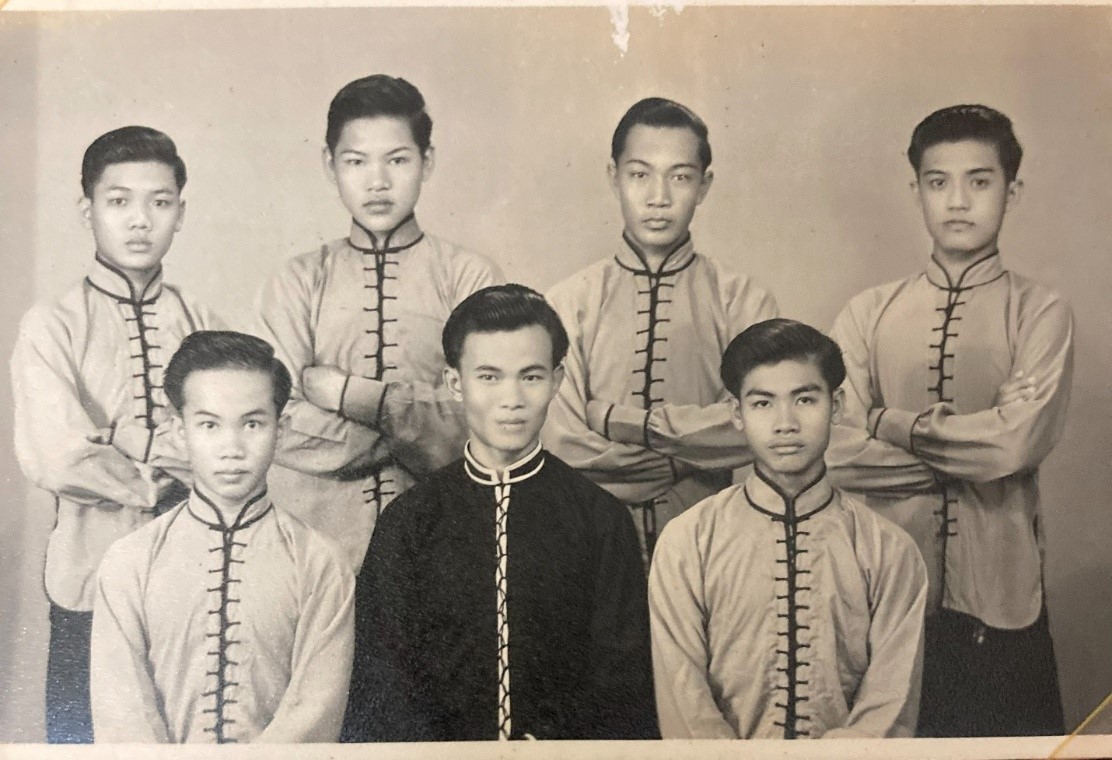
Appreciating my dedication and potential, they also taught me two Wushu forms of the classic Lion Dance, which has deeper significance beyond being entertaining. I first learned the Southern form, and later, the acrobatic Northern form which requires more strength, coordination, flexibility and precision jumping. Performed for cultural, religious and major events, the dance depicts the movements of lions, warding off evil and conveying luck and good fortune. Despite being a junior student, I got to go on my very first trip to Singapore and perform with the senior students. I was about 18 at the time.
Perhaps my only regret from those teenage days was that I didn’t learn to play the drums that actually drive the Lion Dance performance. But it was a life lesson. To learn something well, you need to focus on one thing at a time. Even with the Lion, two people are required to precisely coordinate and maneuver the costume, one person at the head and the other at the tail section. I learned the tail first. In those days, the lion’s head was heavy and clumsy compared to the ones constructed today; you needed a lot of strength and coordination. Eventually, I was able to do both sections of the costume.
Despite my passion and time spent for Wushu competitions and performances, I kept up with my schoolwork, and completed the Form 5 O-level exam at the Methodist English School. I later worked there as a temporary teacher for 10 years. I provided administrative assistance, served as a Form 4 form-teacher and taught Science, Art, and English.
I got married in 1968 when I was 27. When the school converted into the Methodist High School on Silibin Road, there were new regulations and temporary teachers were not needed. I then became a salesman for a diesel company which supplied the tin mines. I did that for more than 10 years until the mining industry collapsed and I went into some business on my own.
During those years, there was little time for advancing my Wushu training but I continued to practice a little when I could.
In 1987, my wife decided that she wanted to learn Taichi and I agreed to accompany her. Taichi is slow moving. It’s a different form of Wushu that is also based on martial arts but is primarily for exercise. Because of my former training, it was easy to learn the different forms of Taichi like the 37-step Yang style. Our first teacher was Hew See Lin.
We soon heard about the upcoming Asian Games competition to be held in China in 1990. It was going to be the first time that Wushu would be included in the Games and Malaysia considered sending a team. Preparations began first at the state level. In 1989, Perak’s Wushu Association held its competition and I was selected to train at the national level.
At that time, Lim Keng Yaik was Minister for Primary Industries as well as President of the National Wushu Association. With his connections, three teachers were recruited from China to coach the inaugural national team. I was lucky to also be selected for this special training.
To be continued in Part 2