
By Rosli Mansor Ahmad Razali
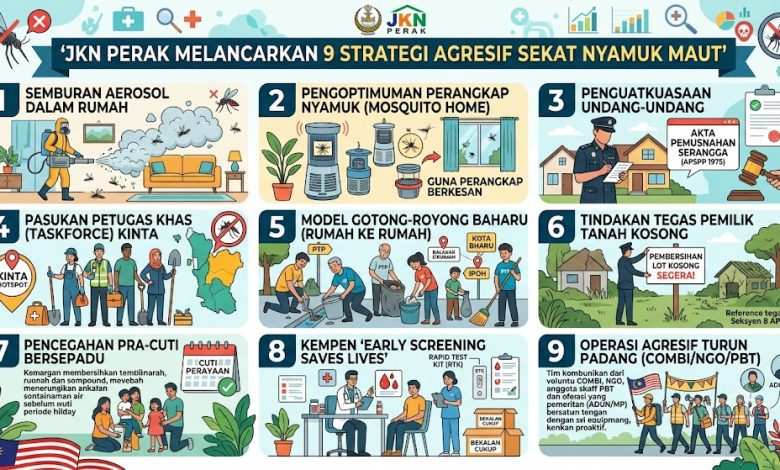
IPOH: Following the first recorded dengue fatality in Perak, the Perak State Health Department (JKN Perak) has moved swiftly to launch nine aggressive measures aimed at wiping out Aedes mosquito breeding sites and preventing further loss of life.
Among the immediate interventions being enforced are indoor aerosol spraying, the optimal deployment of mosquito traps (mosquito homes), and large-scale law enforcement operations in outbreak areas.
The Kinta district, which is currently identified as the primary hotspot, is being targeted through the establishment of a special inter-district task force. The team has already executed five source reduction and eradication operations, with the next major sweep scheduled to take place at Cherry Apartment in early July.
To maximise frontline logistics and operational strength, JKN Perak has mobilised personnel from neighbouring districts—namely Kuala Kangsar, Kampar, and Perak Tengah—alongside officers from the JKN headquarters to expedite case investigations and field preventive controls.
Additionally, Perak has introduced a new, enhanced communal cleanliness (gotong-royong) model. This initiative focuses on rigorous house-to-house inspections, multi-agency collaboration, efficient junk management, active youth engagement, and stern legal action against owners of overgrown vacant lots under Section 8 of the Destruction of Disease-Bearing Insects Act (APSPP) 1975.
The department’s comprehensive strategy is further strengthened by integrated pre-holiday dengue prevention activities conducted statewide before festive breaks, ensuring mosquito density in high-risk localities is suppressed to a minimum.
Concurrently, early detection capabilities are being enhanced through the ‘early screening saves lives’ campaign targeting both public and private medical practitioners. This is supported by the strict monitoring of Dengue Rapid Test Kit (RTK) supply lines to ensure government facilities remain fully stocked.
To ensure no area is overlooked, District Health Offices (PKD) are scaling up aggressive field operations by optimising the roles of Communication for Behavioural Change (COMBI) teams and non-governmental organisations (NGOs) to pinpoint high-risk zones.
This initiative is driven by close partnerships forged with key stakeholders—including local councils (PBT), State Assemblymen (ADUN), Members of Parliament, and other relevant departments—to seamlessly share manpower and machinery. For administrative record, an Event-Based Surveillance (EBS) report on the situation was officially submitted on June 25 for further follow-up action.